THE PROJECT
Corequisite Education in California
Infusing Motivationally-Supportive Practices in Corequisite Coursework in California Community Colleges

THE CONTEXT & CHALLENGE
Motivate Lab is collaborating with the California Community Colleges Chancellor’s Office in their initiative dedicated to achieving equitable placement for enhanced student success under the AB 705 legislation, AB 1705, and ESS 23-08 implementation requirements. These statutes are aimed at implementing a corequisite model for math and English courses to help students remain engaged and motivated during their college transition.
THE PARTNERSHIP
Motivate Lab was selected as an external Partner to provide colleges with support in meeting the challenge of achieving equitable placement. With funding from the Chancellor’s Office, Motivate Lab has been helping California Community Colleges elevate the success of corequisite courses in the state. Our team is dedicated to supporting faculty through professional development opportunities, aiming to uplift pedagogical practices that support students’ learning mindsets and holistic success. This collaboration contributes to broader efforts aimed at enhancing student outcomes and closing equity gaps while driving impact in the classroom and creating motivationally supportive institutional cultures within Math and English departments.
This work is anchored by a multi-year partnership between Motivate Lab and the California Community Colleges Chancellor’s Office (CCCCO). Together, we’ve engaged Math and English corequisite faculty, students, department chairs, and administrators across three cohorts of institutions — scaling from an initial group of 5 institutions to a statewide reach of 29 institutions. We have also worked closely with institutional research offices at these institutions and the research team at the Chancellor’s Office to collect data and evaluate the effectiveness of this work.
THE APPROACH
The Motivating Learners Course
One starting place for creating supportive institutional cultures in corequisite classes is how instructors design the classroom learning experience, particularly in corequisite Math and English courses that have historically been barriers for too many students. Motivate Lab has helped train Math and English faculty who teach corequisite courses over three years on Learning Mindsets. Highlights from this work include:
- Since 2023, approximately 300 corequisite Math and English instructors have completed our Motivating Learners Course.
- Motivate Lab created customized Math and English versions of the Motivating Learners Course.
- Math and English instructors had opportunities to take the course alongside disciplinary colleagues from other institutions. This provided instructors opportunities to learn from and share resources with colleagues across institutions.
- Created by faculty who participated in the course, Motivate Lab curated an online repository of projects and materials. The repository provided examples and helped spark ideas for how participants were implementing motivationally supportive practices in their Math or English corequisite courses.
Convenings & Webinars
Throughout the three year project, Motivate Lab hosted a series of convenings designed to increase opportunities for learning and sharing knowledge across institutions. Convenings were a mix of in-person regionally organized meetings and online webinars. In a state as large as California, creating flexible and regional options for engagement provided greater opportunities for engagement networking. Many of these meetings showcased successful curricular practices of faculty who had previously participated in the Motivating Learners Course and adopted these practices in their classrooms.
THE LEARNINGS
Real Results from Real Practitioners
Hear from a recent corequisite faculty member at Cuesta College as she shares her experience with the course and how it transformed her teaching:
THE FINDINGS
Although we are still collecting statewide data on student outcomes, preliminary findings from one institution provide compelling evidence that participating in the Motivating Learners Course leads to positive student gains:
One starting place for creating supportive institutional cultures in corequisite classes is how instructors design the classroom learning experience, particularly in corequisite Math and English courses that have historically been barriers for too many students. Motivate Lab has helped train Math and English faculty who teach corequisite courses over three years on Learning Mindsets. Highlights from this work include:
- Since 2023, approximately 300 corequisite Math and English instructors have completed our Motivating Learners Course.
- Motivate Lab created customized Math and English versions of the Motivating Learners Course.
- Math and English instructors had opportunities to take the course alongside disciplinary colleagues from other institutions. This provided instructors opportunities to learn from and share resources with colleagues across institutions.
- Created by faculty who participated in the course, Motivate Lab curated an online repository of projects and materials. The repository provided examples and helped spark ideas for how participants were implementing motivationally supportive practices in their Math or English corequisite courses.
We have also started examining the impact of changes in instructional practices on student learning outcomes. For example, in one sample of instructors from one large community college, we found that students of instructors who participated in the professional development were more academically successful than students whose instructors did not participate (e.g., a 4.9% increase in pass rates). The professional development was particularly effective for students from lower resource backgrounds (e.g., a 5.9% increase in pass rates). 1
Impact of the Motivating Learners Course on Math and English Course Pass Rates
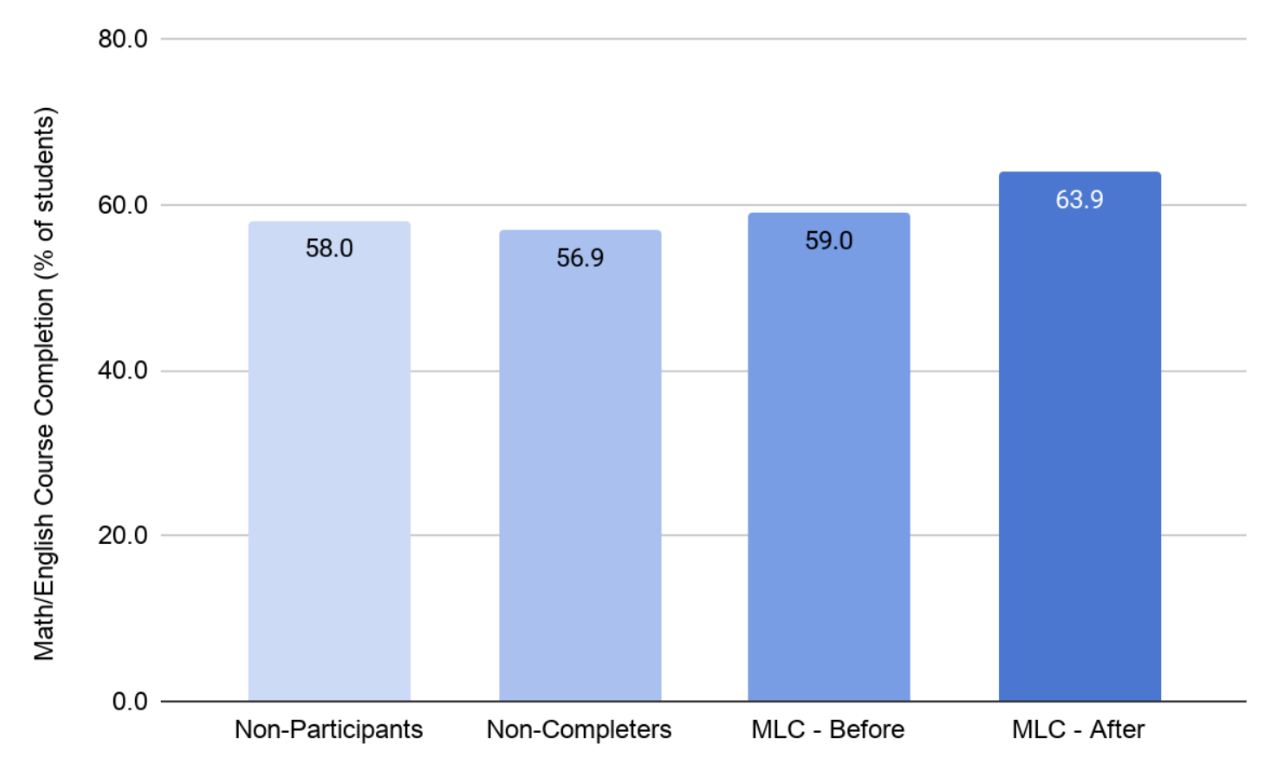
Figure 1: Non-Participants = math and English course pass rates for instructors who never signed up for the Motivating Learners Course; Non-Completers = math and English course pass rates for instructors who signed up for the Motivating Learners Course but did not complete it; MLC – Before = math and English course pass rates for the semester before instructors participated in and completed the Motivating Learners Course; MLC – After = math and English course pass rates for the semester after instructors participated in and completed the Motivating Learners Course. Adapted from Hulleman et al. (under review).
NEXT STEPS
Our work in California continues to grow! We have expanded the scope of our partnerships through a new California Motivation Institute, which provides professional development through the Motivating Learners Course and guided Communities of Practice at individual CCC institutions. If you are interested in learning more about becoming an institutional partner, please reach out to Antoinette Magee at Antoinette@MotivateLab.org.
Interested in collaborating with us in areas beyond math and English?
From policy to practice. From practice to impact.
FOOTNOTES
1 Methodological details: In this data set, we examined 29 instructors who completed the Motivating Learners Course, 15 who signed up but did not complete it, and 136 who had the opportunity to sign up but who did not show interest in the course. Collectively, these three groups taught tens of thousands of students across mathematics and English courses.
To analyze the data, we used a “difference in differences” approach to compare how grades changed within the same instructor’s courses before and after they completed the course, relative to how grades changed over the same period for instructors who did not complete it. This provides a more rigorous test of the effects of taking the MLC than simply comparing instructors who participated in the course to instructors who did not.
We also statistically accounted for other important variables, including differences between individual instructors, between courses, between course modalities (i.e., in-person, online), and across semesters, so that these differences did not confound the impact of the course.